Graham Mackrell explores the diversification of a time-tested technological staple
Since the industrial revolution of the 18th century, the use of gears has become both commonplace and crucial. From the tiny gearbox in your car’s windscreen wipers to the gears keeping process pumps in oil refineries operational, it is difficult to think of many modern applications where gears are not a critical component.
 As such, it should come as no surprise that the global market for gearboxes and geared motors has seen unceasing growth over the past decade, with the only exception being a brief decline during 2009’s financial crisis. This has showed no sign of changing, with the market value expected by Frost & Sullivan to reach US$15.67 billion by 2017.
To remain effective across such a broad spectrum of applications, gears have diversified since Aristotle first wrote of Archimedes’ gear wheels. Althoguh many variations are available on the market today, only four core types are widely used, each with their own advantages and disadvantages.
The spur gear
The spur gear is the most commonly used gear type and, as a result, has become iconic – so much so that, if you were to ask a child to draw a gear, they would almost certainly doodle something resembling a spur gear.
Characterised by protruding teeth, spur gears have a place in everything from washing machines to power plants. This is largely a result of their low cost and ease of installation, but is also due to their constant velocity ratio and ability to transmit large amounts of power (up to 50,000kW) efficiently.
However, engineers considering using these gears should think about the nature of their application beforehand. The high backlash of spur gears means that they are unsuitable for environments where precision is essential, as any fitted backlash compensation cannot be maintained throughout the gear’s life without regular adjustment. The gear teeth also experience high levels of stress, something that frequently culminates in teeth breakage.
Although they may be efficient in terms of power transmission, this is not the case for space and sound. Spur gears are cumbersome, in terms of both bulk and weight, and this can throw up problems in regards to an application’s design. If a compact gear is necessary or if the end product needs to be lightweight and easily manoeuvrable, these gears are far from ideal.
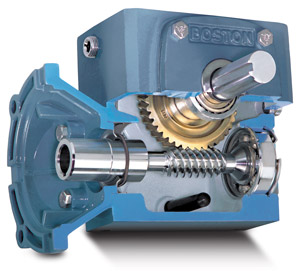
The worm drive
A better solution to meeting these particular requirements would be the worm drive. In much the same way that an earthworm has two brains, the worm drive has two parts – the worm gear, a screw-shaped component at the top of the drive, and the worm wheel, which looks similar to a spur gear.
However, unlike the spur gear, worm drives occupy little space due to the more compact nature of their design. This design also affords several other advantages, such as increased torque and less stress on gear teeth due to the worm gear’s spiral thread.
Where the worm drive falls short is precision, only offering relatively good precision after modification. However, in modifying the system to increase surface contact pressure the stress and wear on the teeth increases, reducing overall gearbox efficiency.
Planetary gears
If you consider the solar system and think of how each planet and satellite’s gravitational field hangs in accurate stability, a similar thing happens with planetary gears. Also known as epicyclic gears, they are a number of gears – referred to as planets – that rotate around a central gear, all within an outer ring gear, or annulus.
Because of their compact yet complex design, planetary gears provide a higher power density than typical gearing systems, as well as over 95% efficiency and increased stability. Depending on the amount of planets in the system, which is typically between three and five, the torque density of the gear trains is relatively high as the load is shared between each planet.
The complexity of the design brings a handful of disadvantages though, namely in terms of cost and maintenance. As there are more components within these systems they are generally more expensive and the higher number of components also means that there are more parts that need to be maintained frequently.
Fortunately, planetary gears can be enhanced without the same kind of repercussions that come from modifying worm drives. Harmonic Drive has launched a range of enhanced planetary gears that consistently maintain accuracy to one arc minute through use of a flexible ring gear. This allows the automation and packaging industry to utilise precise gears that are better suited to their requirements.
Strain wave gear
The strain wave gear is essential in applications that require the highest quality of accuracy and power density. Known colloquially as a harmonic drive, it consists of just three components: the circular spline, a fixed outer ring with gear teeth on the inside; the flexspline, a flexible inner ring with outer gear teeth; and the wave generator, which is a special ball bearing assembly which is mounted to an elliptical plug and is usually attached to the input shaft.
This three-part design means the versatility of strain wave gears is second to none, with a very low weight, high torque and single stage ratios that range from 30:1 to 320:1. In case that doesn’t provide enough options, they can provide a large hollow shaft allowing for services or supply lines to be passed through the centre of the gear.
Characteristics such as this are the reason strain wave gears are trusted for use in all manner of highly demanding applications, such as aerospace and also by NASA for use in the Mars Rover.
The humble gear has come a long way from its use in the underrated hobbies of Archimedes to become the backbone of modern machinery, and it has been endlessly redesigned and reapplied in the pursuit of perfect performance. As a result, there is now a gear for every business – it’s just a matter of choosing the right one.
Graham Mackrell is with Harmonic Drive.
http://www.engineerlive.com/content/getting-gears
As such, it should come as no surprise that the global market for gearboxes and geared motors has seen unceasing growth over the past decade, with the only exception being a brief decline during 2009’s financial crisis. This has showed no sign of changing, with the market value expected by Frost & Sullivan to reach US$15.67 billion by 2017.
To remain effective across such a broad spectrum of applications, gears have diversified since Aristotle first wrote of Archimedes’ gear wheels. Althoguh many variations are available on the market today, only four core types are widely used, each with their own advantages and disadvantages.
The spur gear
The spur gear is the most commonly used gear type and, as a result, has become iconic – so much so that, if you were to ask a child to draw a gear, they would almost certainly doodle something resembling a spur gear.
Characterised by protruding teeth, spur gears have a place in everything from washing machines to power plants. This is largely a result of their low cost and ease of installation, but is also due to their constant velocity ratio and ability to transmit large amounts of power (up to 50,000kW) efficiently.
However, engineers considering using these gears should think about the nature of their application beforehand. The high backlash of spur gears means that they are unsuitable for environments where precision is essential, as any fitted backlash compensation cannot be maintained throughout the gear’s life without regular adjustment. The gear teeth also experience high levels of stress, something that frequently culminates in teeth breakage.
Although they may be efficient in terms of power transmission, this is not the case for space and sound. Spur gears are cumbersome, in terms of both bulk and weight, and this can throw up problems in regards to an application’s design. If a compact gear is necessary or if the end product needs to be lightweight and easily manoeuvrable, these gears are far from ideal.
The worm drive
A better solution to meeting these particular requirements would be the worm drive. In much the same way that an earthworm has two brains, the worm drive has two parts – the worm gear, a screw-shaped component at the top of the drive, and the worm wheel, which looks similar to a spur gear.
However, unlike the spur gear, worm drives occupy little space due to the more compact nature of their design. This design also affords several other advantages, such as increased torque and less stress on gear teeth due to the worm gear’s spiral thread.
Where the worm drive falls short is precision, only offering relatively good precision after modification. However, in modifying the system to increase surface contact pressure the stress and wear on the teeth increases, reducing overall gearbox efficiency.
Planetary gears
If you consider the solar system and think of how each planet and satellite’s gravitational field hangs in accurate stability, a similar thing happens with planetary gears. Also known as epicyclic gears, they are a number of gears – referred to as planets – that rotate around a central gear, all within an outer ring gear, or annulus.
Because of their compact yet complex design, planetary gears provide a higher power density than typical gearing systems, as well as over 95% efficiency and increased stability. Depending on the amount of planets in the system, which is typically between three and five, the torque density of the gear trains is relatively high as the load is shared between each planet.
The complexity of the design brings a handful of disadvantages though, namely in terms of cost and maintenance. As there are more components within these systems they are generally more expensive and the higher number of components also means that there are more parts that need to be maintained frequently.
Fortunately, planetary gears can be enhanced without the same kind of repercussions that come from modifying worm drives. Harmonic Drive has launched a range of enhanced planetary gears that consistently maintain accuracy to one arc minute through use of a flexible ring gear. This allows the automation and packaging industry to utilise precise gears that are better suited to their requirements.
Strain wave gear
The strain wave gear is essential in applications that require the highest quality of accuracy and power density. Known colloquially as a harmonic drive, it consists of just three components: the circular spline, a fixed outer ring with gear teeth on the inside; the flexspline, a flexible inner ring with outer gear teeth; and the wave generator, which is a special ball bearing assembly which is mounted to an elliptical plug and is usually attached to the input shaft.
This three-part design means the versatility of strain wave gears is second to none, with a very low weight, high torque and single stage ratios that range from 30:1 to 320:1. In case that doesn’t provide enough options, they can provide a large hollow shaft allowing for services or supply lines to be passed through the centre of the gear.
Characteristics such as this are the reason strain wave gears are trusted for use in all manner of highly demanding applications, such as aerospace and also by NASA for use in the Mars Rover.
The humble gear has come a long way from its use in the underrated hobbies of Archimedes to become the backbone of modern machinery, and it has been endlessly redesigned and reapplied in the pursuit of perfect performance. As a result, there is now a gear for every business – it’s just a matter of choosing the right one.
Graham Mackrell is with Harmonic Drive.
http://www.engineerlive.com/content/getting-gears


 The
sale pricing that is now attached to the GMC brand of transmission
inventory that we're promoting is scheduled to remain through the rest
of this year as a special incentive.
The
sale pricing that is now attached to the GMC brand of transmission
inventory that we're promoting is scheduled to remain through the rest
of this year as a special incentive.